Article: Why October Is Filipino American History Month
Why October Is Filipino American History Month
The history behind the month, and why it matters to a house of modern Filipiniana in Los Angeles.
Filipino American History Month is observed every October in the United States. It marks October 18, 1587, when Filipino sailors aboard the Spanish galleon Nuestra Señora de Esperanza came ashore at what is now Morro Bay, California: the earliest documented Filipino presence in the continental United States. The Filipino American National Historical Society proclaimed the observance in 1991, first marked it in 1992, and the United States Congress recognized it by resolution in 2009.
That is the short answer. The longer one is worth knowing.
Why October
The men who landed at Morro Bay were crew on the Manila galleon trade, the route that linked Manila and Acapulco for roughly two and a half centuries. Spanish records called them Luzones Indios, people of Luzon. When the ship anchored off the Central California coast to take on water and supplies, Filipino crew members were among those sent ashore first as scouts.
October carries a second date. Larry Itliong, the labor organizer born in San Nicolas, Pangasinan, on October 25, 1913, led the Filipino farmworkers who began the 1965 Delano grape strike. The strike that most Americans associate with Cesar Chavez was started by Itliong and his members. California now observes Larry Itliong Day each October 25.
History, not only heritage
The month was established by the Filipino American National Historical Society (FANHS), founded in 1982 by Fred and Dorothy Cordova to research and preserve the Filipino American record. The choice of the word history was deliberate. The intent was to recognize a documented presence and its consequences, not simply to celebrate culture.
Recognition followed in stages. California placed the month on its statewide education calendar in 2006. In 2009, the U.S. Senate passed Senate Resolution 298 by unanimous consent, and the House followed with House Resolution 780. Congress passed similar resolutions in 2010 and 2011, though national recognition has not been made permanent. Today, states, counties, cities, and school districts across the country issue their own proclamations each year.
The galleon and the cloth
The Filipino story in America begins on a trade route, and much of what that route carried was cloth. For a house built on Philippine textiles, the detail is not incidental.
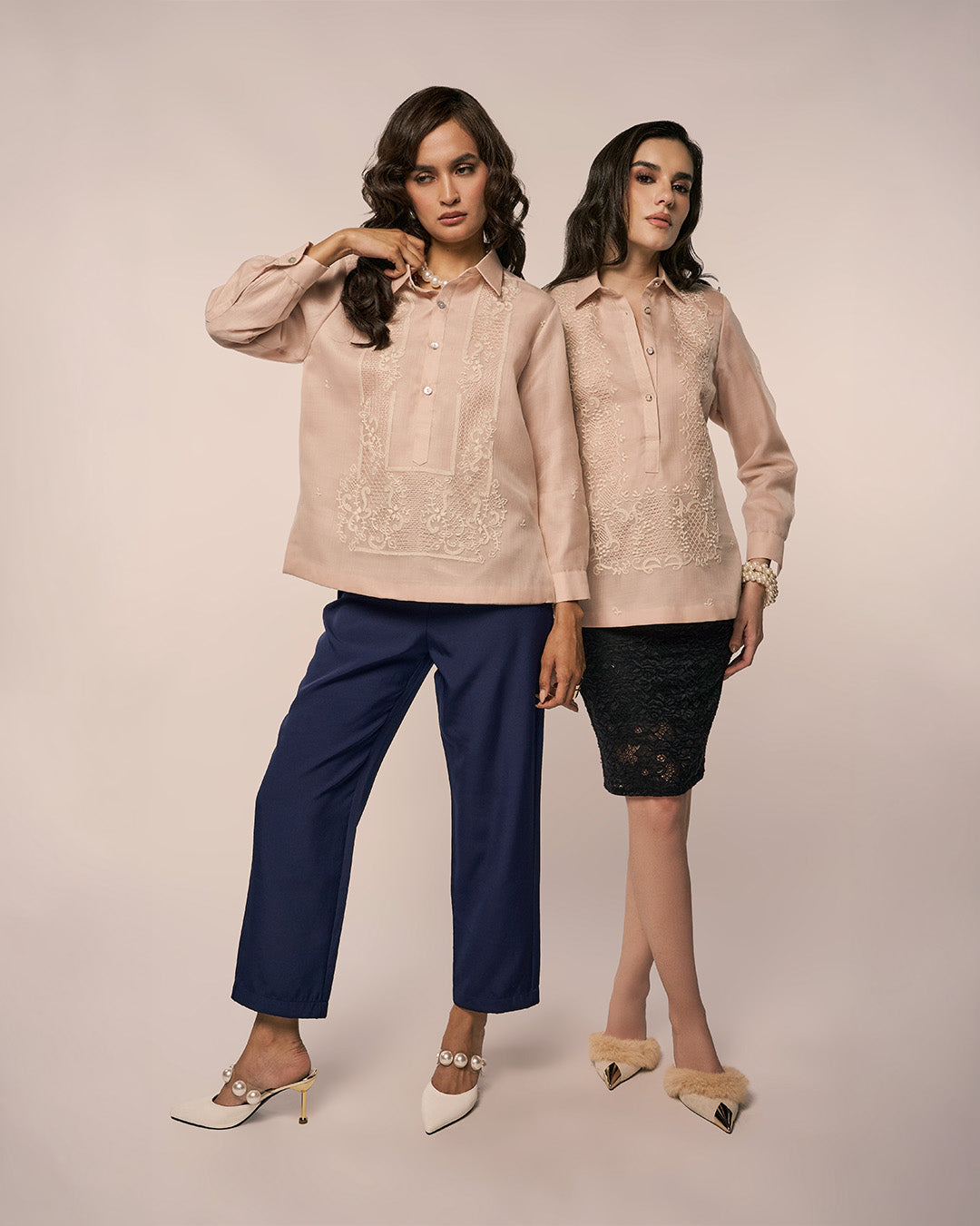
The Mestizo works with handwoven Philippine fabrics, including Mangyan and Binakol weaves, each the specialized craft of a particular region and community. Piña, woven from pineapple leaf fiber, gives the barong its translucence and its formality. These are not decorative references to the past. They are living crafts, and the house works with them to support the weaving communities that sustain them and to place them in clothing meant to be worn now.
Los Angeles
Los Angeles is home to one of the largest Filipino communities outside the Philippines. In 2002, after a campaign of roughly thirty years, the city designated Historic Filipinotown, just west of downtown, as a historic-cultural neighborhood. Within it, the Filipino Christian Church, designated a Los Angeles Historic-Cultural Monument in 1998, remains one of the oldest anchors of the community.
The Mestizo was founded in Los Angeles in 2021, with production coordinated in Manila and its shop in Culver City. The house exists between those two cities, which is also where the history of this month sits.
Wearing heritage without wearing a costume
The question every heritage house answers, whether it says so or not, is how culture should be worn. Our answer is that heritage dress should feel natural on the body and in the present. A piña barong at a wedding, a terno silhouette reworked for an evening, a handwoven textile cut into a jacket: each lets the wearer carry their roots without turning them into display.
That principle extends past the Filipino community. Philippine textiles are the work of skilled hands and deserve to be worn by anyone who values them. Pride in where something comes from is not limited to the people who come from there.
Beyond October
The month ends. The history does not. A few ways to stay close to it:
- Read the record. FANHS and its regional chapters publish research, oral histories, and archives year-round.
- Visit the places. A monument at Coleman Park in Morro Bay, dedicated in 1995, marks the 1587 landing. In Los Angeles, Historic Filipinotown holds murals, churches, and community institutions worth an afternoon.
- Learn the names. Larry Itliong, Philip Vera Cruz, and the Manong generation of farmworkers shaped American labor history.
- Know the cloth. Ask where a textile was woven, by whom, and how. The answer is usually a story about a place.
The Mestizo welcomes private fittings at the shop in Culver City for those who want to see these textiles in person.
Frequently asked questions
When is Filipino American History Month?
Every October, nationwide in the United States.
Why is it observed in October?
It marks October 18, 1587, when Filipino sailors landed at Morro Bay, California, the earliest documented Filipino presence in the continental United States. October is also the birth month of labor leader Larry Itliong (October 25, 1913).
Who established Filipino American History Month?
The Filipino American National Historical Society. Its board of trustees passed the resolution in 1991, and the first observance took place in October 1992.
Is Filipino American History Month officially recognized?
Yes. The U.S. Senate and House passed resolutions recognizing it in 2009, with further resolutions in 2010 and 2011. California recognizes it statewide, and many states and cities issue annual proclamations. It is not a federal holiday, and national recognition has not been made permanent.
Is it Filipino American History Month or Heritage Month?
The founding organization uses History Month, to emphasize the documented Filipino American record. Asian American and Native Hawaiian/Pacific Islander Heritage Month is observed separately in May.
Where can I learn about Filipino American history in Los Angeles?
Historic Filipinotown, designated by the City of Los Angeles in 2002, is the center of the community's history in the city, with landmarks including the Filipino Christian Church.

Leave a comment
This site is protected by hCaptcha and the hCaptcha Privacy Policy and Terms of Service apply.